














Please choose your location and language

America
Australia
Europe
Asia & Pacific
Middle East & Africa

Please choose your location and language

America
Australia
Europe
Asia & Pacific
Middle East & Africa
Weller Tools GmbH
WX Smart Background

Soldering Wire

Filter your products
43 products
Filter your products

WSW Solder Wire for Reliable Solder Joints


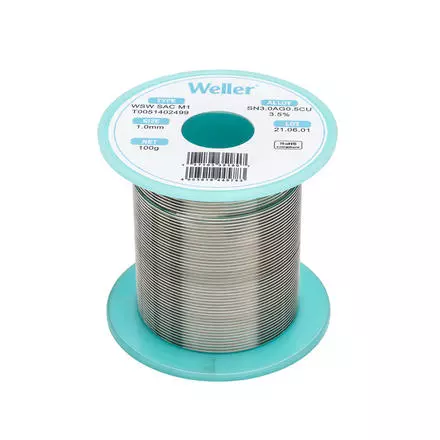
Whether a solder joint holds reliably or needs rework often comes down to the solder wire itself. Weller's WSW solder wire features a 100% continuous flux core, with no voids and no air pockets. Our range includes products in three lead-free alloys with diameters from 0.2 to 1.6 mm. Alongside WSW solder wire in various alloys and diameters, we also offer desoldering braid and solder wire dispensers. Explore our range of professional solder wire for every application.

Weller-tools-landingpage-solder-wire-image-solder-wire-web

Continuous Flux Core: The Difference from Conventional Solder Wire
 

With conventional solder wire, gaps in the flux core are a common issue. Anyone who solders professionally knows what that means: uneven wetting and solder joints that need reworking. With WSW solder wire, this isn't a concern. The flux is distributed evenly across the entire length of the wire because the core runs through without interruption. The result is homogeneous, crack-free solder joints, even on surfaces that are difficult to wet.

WSW solder wire is made from particularly high-quality materials, reducing tip consumption by up to 70%. That means fewer tip changes and less downtime in production.
 

Choosing the Right Solder Wire: Alloy and Diameter

The right solder wire depends mainly on the solder joint and the application. As a rule, the smaller the joint, the finer the wire. For SMD work, use 0.3 to 0.5 mm. For standard PCB soldering, 0.5 to 0.8 mm is the right choice. For larger connections, go with 1.0 to 1.6 mm.

Our range offers three lead-free alloys. SAC (tin-silver-copper) is the standard: the silver content improves the mechanical properties of the solder joint, as with the WSW SAC M1 0.8mm and WSW SAC M1 0.5mm. SC (tin-copper) contains no silver and is the cost-effective alternative. SCN (tin-copper-nickel) adds nickel for specialist requirements, as with the WSW SCN M1 SOLDER WIRE 1.0MM.

Several flux types are available: L0, for example, is halogen-free, which is a requirement in the automotive and medical technology sectors. M1 is the standard type. Spool sizes range from 10 g kits through 100 g and 250 g up to 500 g.

Weller-tools-landingpage-solder-wire-product-solder-wire-web-new
Frequently asked questions
  1. What solder wire diameter do I need?

    Choose based on the size of the solder joint. Fine SMD soldering calls for 0.3 to 0.5 mm, most PCB work is best done with 0.5 to 0.8 mm, and for larger solder joints, use 1.0 to 1.6 mm.

  2. What does "halogen-free" mean for solder wire?

    L0-type flux contains no halogens and leaves less aggressive residue on the solder joint. In industries with strict cleanliness requirements, such as automotive and medical technology, halogen-free solder wire is mandatory. For most other applications, like general electronics, the standard M1 flux type is sufficient.

  3. What's the advantage of a continuous flux core?

    Every centimetre of solder wire contains the same amount of flux. With no voids or gaps, solder joint quality stays consistent. This means less rework and reduced scrap.

  4. What is desoldering braid used for?

    Desoldering braid removes excess solder or corrects faulty solder joints. The fine copper braid absorbs molten solder through capillary action. The wider the braid, the more solder it can pick up. Our range includes various widths to suit different joint sizes.